
Ralph Bunche House

This is the former home of Ralph Bunche, one of the most impressive humans that you may have never heard of. Bunche had an accomplished career in academia and international relations, and served as Under Secretary-General of the United Nations, making him the highest-ranking American ever in that organization. Bunche graduated from UCLA and Harvard on full scholarships. He taught at Howard University in Washington DC, and worked for the Office of Strategic Services, playing a large role in the decolonization of Africa following the conclusion of the Second World War.
Bunche and his family would make the move to New York following the war to begin working for the United Nations. During the late 40s, he worked as the chief negotiator between the Israelis and Arab states, ultimately winning him the Nobel Peace Prize in 1950. Bunche had commemorative plates made prior to the conclusion of the negotiations with the names of the negotiators. When he presented the plates to them, he was asked what he would have done with them had the peace negotiations failed? Bunche replied that he would have “…broken the plates over your damn heads.”
If this weren’t enough of an incredible resume, Bunche was actively involved in the Civil Rights movement, participating in the March on Washington, as well as marching next to Dr. King at Selma. Bunche purchased this home in Kew Gardens, Queens, in 1952 with the money he made from the Nobel Prize. The former owner was so thrilled he wanted to buy it that he even cut the price. While Kew Gardens was more forward-thinking than some other neighborhoods in terms of race, the Bunche family still faced discrimination.
Bunche was denied entry to the West Side Tennis Club in Forest Hills, Queens. That decision was reversed due to national attention, but Bunche declined the membership offer, stating that it was a one-off based on his accomplishments and that it would not be offered to other Black applicants. Bunche often took stands like this, declining to serve as Under Secretary of State in the Truman administration because of the government’s policy of segregation. Bunche would pass away in 1971, and his family would remain at their 1921 home until 1988. The Ralph Bunche House was landmarked on May 17th, 2005.

Apollo Theater

This might be the most recognizable landmark in Harlem. The Apollo Theater, or the building that would become it, was opened in 1914 on 125th Street. Originally, it was known as Hurtig & Seamon's New Burlesque Theater. The theater had a strict “whites-only” policy when it opened. It would, however, fall into disrepair and go out of business in the 1930s.
In 1933, the building was purchased by Sidney Cohen, who restored it and reopened it as the Apollo. The new theater catered to the local Black population, originally hosting vaudeville performances. While dealing with competition from other venues, the Apollo merged with the Harlem Opera House. The programming would eventually shift, with Duke Ellington, Dizzy Gillespie, Count Basie, and other jazz bands performing as well as launching the career of Ella Fitzgerald.
One of the most famous events at the Apollo is Amateur Night, which began in 1934. In 1976, the theater closed after a slow decline; luckily, it was re-opened later that year. The Apollo underwent restorations in the 2000s, with the interior being refurbished in 2001 and the exterior in 2005. The theater is a rare double landmark, with both its interior and exterior receiving designations on June 28th, 1983.
205 DeKalb Avenue

This home at 205 DeKalb Avenue dates back to the 1860s and is most notable for being the home of Dr. Susan McKinney-Stewart, the first Black woman to graduate from medical school in the state of New York. Dr. McKinney-Stewart was born to a large family in Weeksville, Brooklyn. Her father was a merchant and hog farmer and made a decent living. Her siblings were trailblazers in their own right; her sister was the first Black woman to become a principal in New York. She enrolled in the New York College for Women in 1867. She paid her way through school by teaching in both New York and Washington, D.C. Her enrollment didn’t attract as much attention as you might think due to the fact that her mentor was able to dissuade the press from covering her. Dr. McKinney-Stewart graduated at the top of her class. She pursued a career in homeopathy as it was more accepting toward women and people of color. She began a clinic in Brooklyn and focused primarily on the treatment of children. She became so well known that she began to treat both Black and white patients. She lived in this home with her sister in the 1890s.
In addition to her work in medicine, she worked towards civil rights. She was a member of the Women’s Loyal Union and the Women’s Christian Temperance Movement. These organizations pushed for equal rights for women, for African Americans as well as pushing for women’s suffrage. Dr. McKinney-Smith passed away suddenly in 1918 while working at Wilberforce University in Ohio. She was buried in Greenwood Cemetery. Her home in Fort Greene was landmarked as part of the Fort Greene Historic District on September 26th, 1976.
Trinity Baptist Church Crown Heights
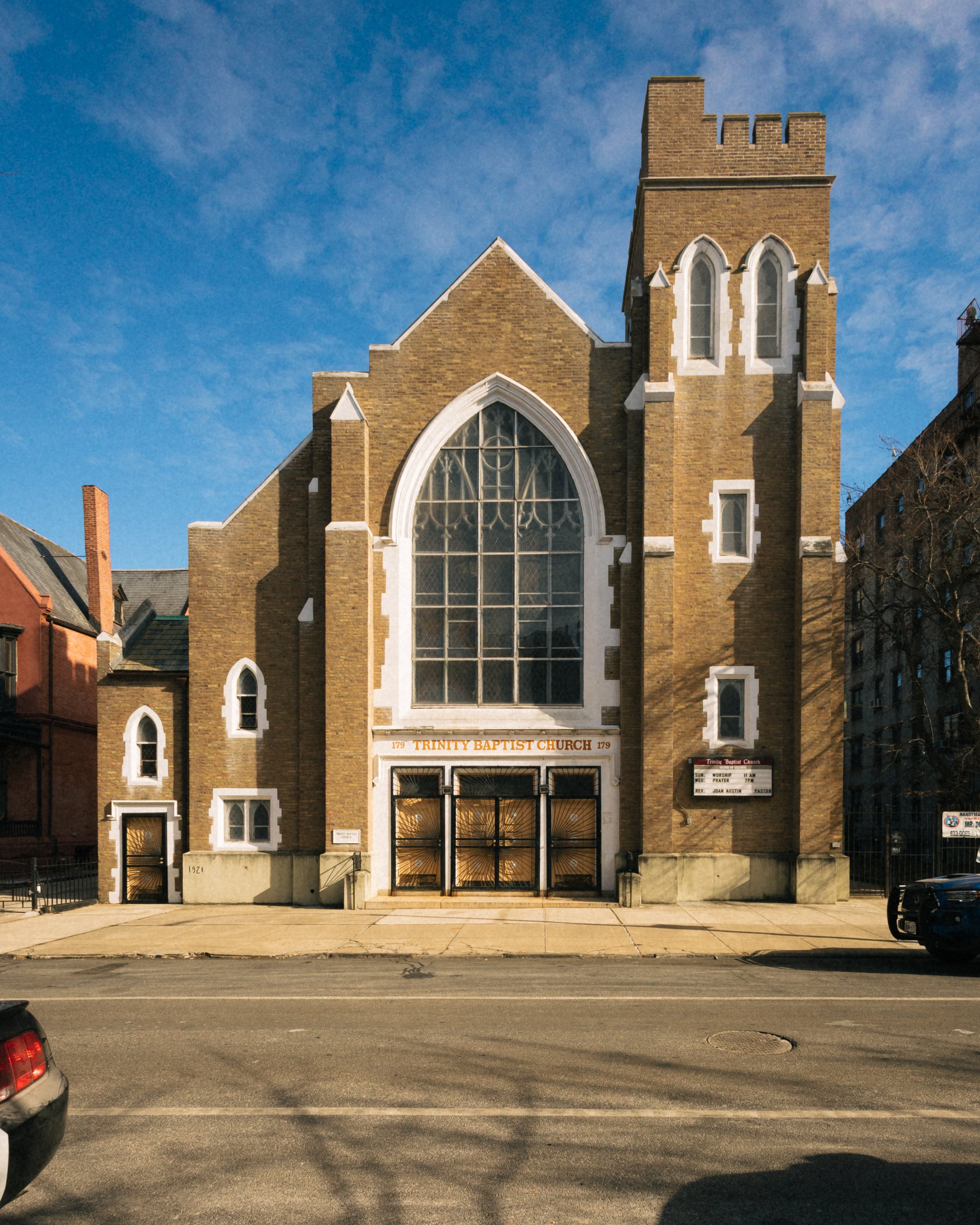
This is Trinity Baptist Church on New York Avenue in Crown Heights. It was founded in 1922 with the mergers of Sumner Avenue and Bedford Heights Baptist Church. The newly combined congregation met in a townhouse located at this location. That would be replaced by the current building in 1927, designed by the firm of Tillion & Million. At the time, the church was completely white, which would begin to change in the 1950s with the changing demographics in the neighborhood. In 1968, they would hire their first Black Pastor, Rev. Richard Boddie.
It would be in 1976 that Trinity hired the Reverend Osborne Scott to be its pastor. Rev. Scott was an army chaplain who helped in the rebuilding of multiple countries following the Second World War. He was also the first Black minister to be appointed to the US Army Chaplain School in 1946. If that weren’t an impressive enough resume, Rev. Scott was also a professor at City College beginning in 1969, where he organized their urban and ethnic studies department. He would pioneer courses in Black, Puerto Rican, and Jewish studies while he was there. Rev. Scott would continue to lead Trinity Baptist Church for over 30 years when he passed away in 1997. The church is still very active in the community, providing HIV-Aids Education, Domestic & Gun Violence awareness, Computer Literacy courses and the Women’s Benevolent Circle. It was landmarked as part of the Crown Heights North Historic District on June 28th, 2011.
155 Mercer Street

155 Mercer Street is an excellent example of a restoration gone right. This building dates back to 1850, when it was constructed by the city of New York as a Fireman’s Hall. Before 1865, firefighting in New York was pretty much made up of a bunch of competing fire companies, not quite Gangs of New York style with firefighters fighting in the street but not that far off.
As a result of this competition, the city built this as a place for them to get together to increase their spirit of cooperation. In 1865, the FDNY was formed, officially professionalizing firefighting, making the Fireman’s Hall obsolete. A few decades later, it was converted into a regular firehouse, with a very unusual mascot, Jenny the monkey who lived in the house for 12 years. In the 1970s, the FDNY vacated the property, which had lost most of its ornamentation, leaving it with a flat and ugly facade.
It would go on to be used as a Mosque in the 80s, followed by a performing arts venue. In 2013, the building underwent a restoration, bringing it back in line with what it looked like in the 1850s, restoring its facade. It housed a Dolce & Gabana before being sold yet again in 2023 for $60 Million and is now home to a Dyson store. I’ve included photos from 1940, 2011, and 2024. It was landmarked as part of the Soho Cast Iron Historic District on August 14th, 1973.


18-20 Christopher Street
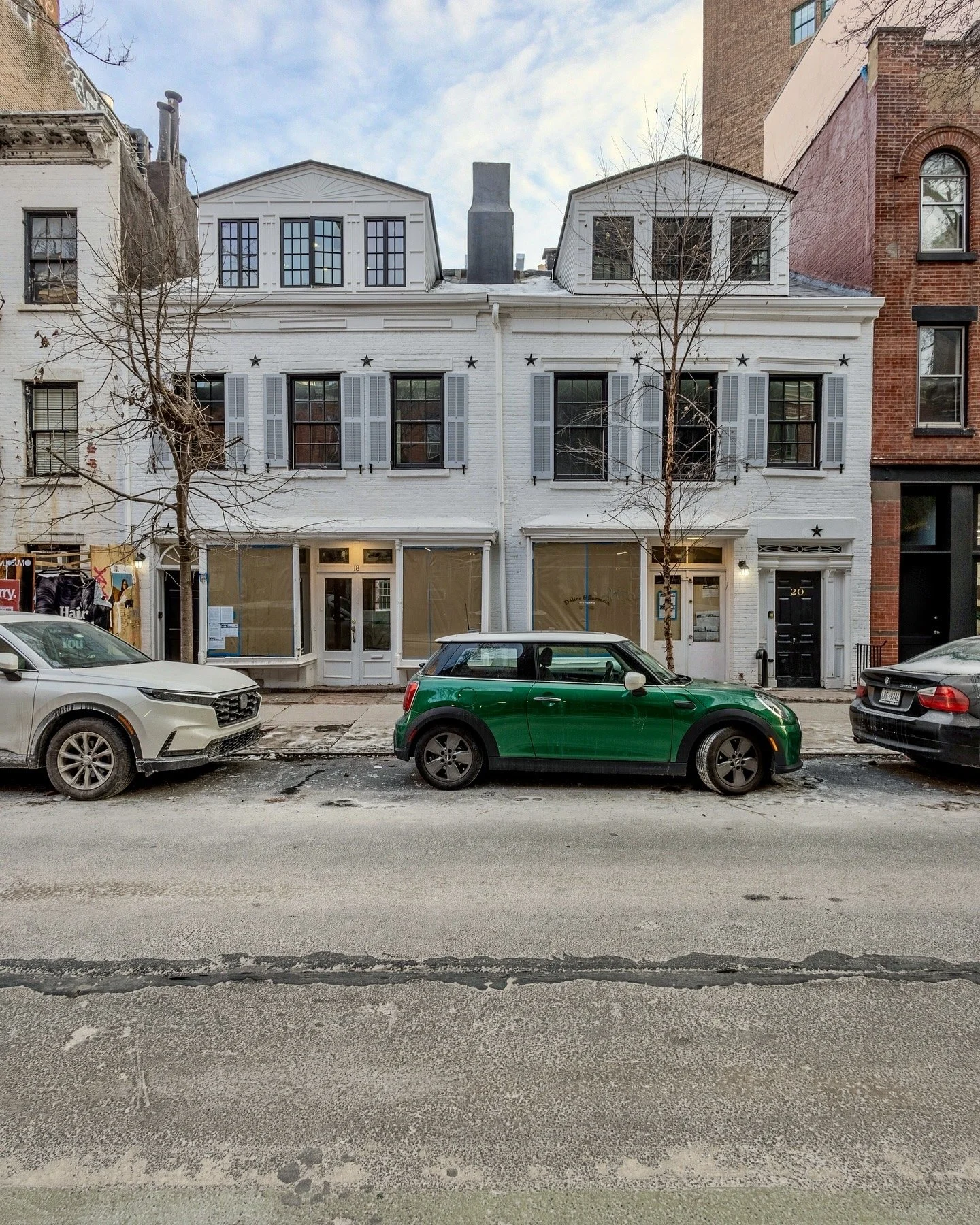

A few years ago, I profiled these two buildings when they were looking a little tired. That said, they are nearly 200 years old, so a little wear and tear can be forgiven. They have recently undergone a restoration, so you can take a look at the before and after, or based on how this is displayed, the after and before. Their origin story will soundly oddly familiar to those of us who stayed in the city during the pandemic. In the early 1800s, Manhattan would regularly have yellow fever epidemics and, on a few terrifying occasions, cholera outbreaks. Those with the means to do so would flee the city to their second homes. In the 1820s, that meant going to the far north countryside known as the Village of Greenwich. That’s where, in 1827, Daniel Simpson would build these two houses at 18 and 20 Christopher Street. They were unique for their time and are still unique today because of their windows on the attic level. Most homes at the time might have an individual dormer for each window as opposed to these “mega” dormers. The plus side is it added another usable floor to the home. Around 1900, the first floor was converted into shops. For those less familiar with New York City geography, that tiny village of Greenwich would eventually turn into Greenwich and the West Village. They were landmarked as a part of the Greenwich Village Historic District on April 29th, 1969.
27 Christopher Street

This is a single family home, this whole building, single family. Before I get to how much it sold for, let’s talk about how it got here. This building was constructed in 1911 for the Switzer Home. This was a charity that allowed immigrant women and girls to live in a safe place and learn skills like sewing or typing. The Switzer sisters were immigrants themselves who ended up making a ton of money and are an excellent example of not pulling up the ladder behind you. In 1932, it was purchased by the St. Joseph’s church to initially house their boys’ school, and eventually the entire school. It would continue to be used for education after that. When the St. Joseph’s school closed in 1974, the building was rented to St. Vincent’s Hospital School of Nursing. In 2002, the building sold yet again, this time for $3 million to the New York Foundling Hospital, which helped “abused, neglected, and abandoned children”. In typical New York fashion, despite all the good this building has done, it was bought and converted into a single-family home in 2014. Its interior was completely gutted and now provides 15,000 square feet of living space. The selling price was $47.5 million. It was landmarked as part of the Greenwich Village Historic District on April 29, 1969.
The Potter Building

This used to be one of the most advanced office buildings in New York City. The Potter Building on Park Row and Beekman Street used to be home to the New York World Newspaper and was built in 1886 by real estate magnate O.B. Potter. It replaced the earlier New York World Building, also owned by Potter, after it was destroyed by fire in 1882. Having suffered heavy financial losses in the fire, Potter resolved to build the most technologically advanced fireproof building at the time, hiring Norris G. Starkweather to be its architect. Its 11 stories were framed by cast iron on the inside as well as red brick and terra cotta on the outside. Its style would have been considered flamboyant even for the 1880s with an eclectic mix of architectural themes. The building was home to multiple newspapers throughout its history as well as law firms and insurance companies. It was converted into co-ops in the 1980s and was landmarked a decade later on September 17th, 1996.
Syms Memorial Operating Theater

Surgery in the 19th Century was not pleasant. Often times it resulted in a patient biting down on a piece of leather while a doctor in a three piece suit went to town on their limb with a saw, generally resulting in death by infection. Towards the end of the century however, that was beginning to change. The Syms Operating Theater was built in 1890 on 59th and 9th, and was the most state of the art facility of its kind in the country. It was designed to be an aseptic operating pavilion for Roosevelt Hospital, and was built at the bequest of William J. Syms, a prominent New York gun maker.
Syms commissioned architect William Wheeler Smith and surgeon Dr. Charles McBurney to build it. McBurney was to have full control of the pavilion’s features, and toured Europe visiting all of the state of the art operating rooms. The result was a building with clean rooms and no porous surfaces, with an amphitheater that could seat 300. McBurney was renowned for his work with the appendix, and discovered the diagnostic spot on the torso for appendicitis which is still known as McBurney’s point. Additionally, he was called to treat president McKinley after he was shot.
The operating theater would remain in operation until 1941 when it became the hospital mortuary. Portions of it were torn down in the 50s for the construction of a large tower behind it. It is now home to the Speyer Legacy School, a private elementary school. It was landmarked by The City of New York on July 11th, 1989.
Greenwood Cemetery Fort Hamilton Gate

This rather spooky building is appropriately the Fort Hamilton Gate House for Greenwood Cemetery in Brooklyn. It was built by Richard M. Upjohn in 1877 along with a smaller visitors lounge directly across the entrance. Upjohn worked with his father, also named Richard Upjohn, on the main entrance to the cemetery on 5th Avenue. Upjohn the elder was also the architect of Trinity Church, while Upjohn the younger would go on to have a distinguished solo career with his crowning achievement being the Connecticut State House. Consistent across both of their works was the high Victorian Gothic style which really came into its own following the Civil War. On the facade of the gatehouse, Upjohn placed images of hourglasses as well as reliefs of different phases of life. While this might seem a touch macabre, it was very common in cemetery architecture at the time. The house served for a time as the official residence of the gatekeeper. It was landmarked on April 12th, 2016.
Montauk Paint Company Building

this is the former Montauk Paint building located on 13th Street and 2nd Avenue in Gowanus, Brooklyn. It was built in 1908 for William Kelly, the President of the Brooklyn Alcatraz Asphalt Company, as an investment property. There used to be stables owned by the company as well next to it. The first tenant of the building was the Montauk Paint Company, which was founded in 1908 by a mother-son duo of Margaret and Frank Cornell. The company manufactured all kinds of paints and varnishes, and because this was the early 1900s, that included “white lead,” so that’s fun. Brooklyn was a center of paint production at this time; however, by the 1930s, the Montauk Paint Company closed up shop, and the factory was rented by Norge Sailmakers, who, as the name implies, manufactured sails. From 2010 to 2023, the building served as a studio for sculptor Mardig Kachian, who moved here from his building on West Street. It most recently sold in 2024 for $5.7 million. According to the website of the agent that sold the building, the property was sold to a “well-capitalized artist.” It was landmarked on October 29th, 2019.
A Chat With The Bowery Boys
I have been late posting this, but back in February I was able to join two of my idols in the New York History space, Greg Young and Tom Meyers, of The Bowery Boys podcast. I got to chat with them on their Patreon specific podcast, Side Streets. We covered a broad range of topics from our favorite landmarks to the creative process of what it takes to make content about the city we call home. If you somehow haven’t heard of The Bowery Boys, they have been making THE New York City history podcast since 2007. Their Side Streets podcast is exclusive to their patrons however they were gracious enough to allow me to share this episode with you. I hope you all enjoy.
Stables at 136 West 18th Street
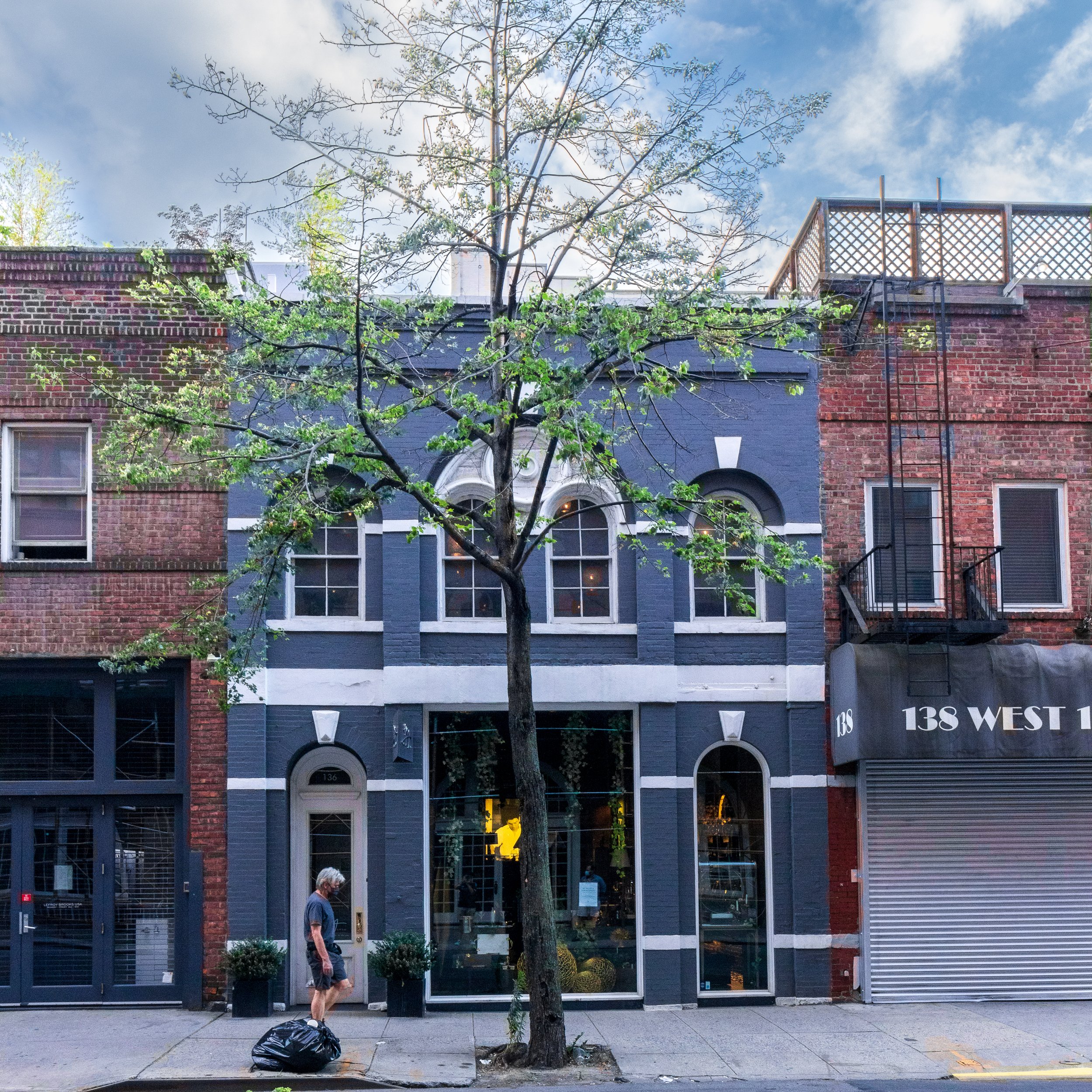
Many of the remaining carriage houses in New York are located on the Upper East side, where they served the upper class during the gilded age. If you look hard enough, however, you can still find some of these wonderful buildings further downtown. This particular one is located at 136 West 18th Street in Chelsea. It was build in 1865 for the Gilman Family who lived on West 20th Street. It was later sold to Charles Landon and Benjamin Hutton, brother in laws and business partners, who ran a successful fabric importing business. They used it for their house on 14th Street, Hutton lived there first then moved out and sold it to Landon, before renting it out. Over the years it has been home to various businesses and has been used as a garage. Currently it is home to the shop of artist Michael Aram. 136 West 18th was landmarked by The City of New York on December 11th, 1990.
The Center
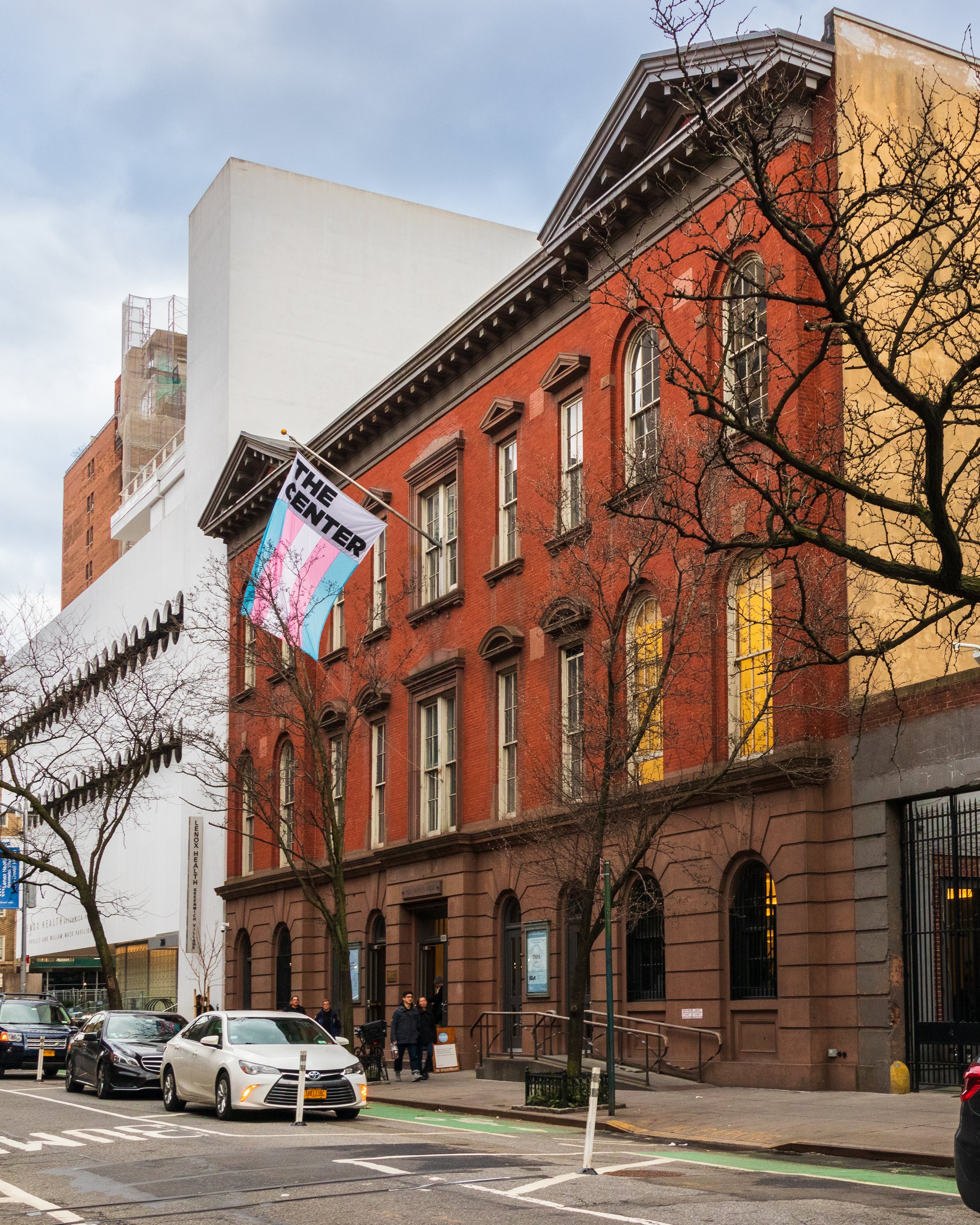
The Village has a long and storied history with LGBTQ+ rights. It’s bohemian openness to different lifestyles made it a hub for the LGBTQ+ community beginning in the early 20th century and the Stone Wall Inn riots in the 60s made the area a focal point in the fight for civil rights. The Lesbian, Gay, Bisexual & Transgender Community Center, otherwise known as “The Center” was founded in 1984 and purchased this former school built in 1869.
The Center served as an important home for multiple LGBTQ+ organizations and offered community outreach including health services, a school for LGBTQ+ Teens and political activism. The Center played a large role in protesting the terrible conditions and lack of funding for Aids patients in the 80s and 90s. A large memorial to the victims of the Aids epidemic can be found a block south in St. Vincent’s Triangle. In more recent history, the Center played host to over 300 weddings on the day that Gay Marriage was legalized in New York State. It is located at 13th and 7th Avenue and was meticulously restored in 2001. It was landmarked on June 18th, 2019 in recognition of the large role it has played in the LGBTQ+ community.
Coney Island Parachute Jump

With Memorial Day kicking off the unofficial start of summer, let’s take a trip down to Coney Island. What once was America’s largest amusement park has a fascinating history. There are multiple theories on where its name came from, the most popular is that it comes from the Dutch word for rabbit “konijn” however even that is disputed. The island was a part of Gravesend and didn’t really begin development until the 1820s. For the middle of the 19th Century it became a high end get away for Manhattan’s wealthy residents, with multiple luxury hotels and later race tracks. The horse racing attracted a different crowd which caused the island’s reputation to suffer, couple that with multiple fires destroying some of the hotels and it was in need of a rebranding.
Enter George C. Tilyou, who decided to open Stepplechase Park in 1897 which unified a bunch of attractions on the boardwalk. His sons would purchase this tower, the parachute jump, from the 1939 World’s fair in Queens. The ride literally had parachutes that would be guided up and down from the top of the tower, it’s a miracle people survived this thing. Steeplechase Park closed in 1964 and the tower went inactive. It was landmarked on May 23rd, 1989.
24 Middagh Street

I just found out my favorite house in Brooklyn is for sale, so donations are welcome. The word compound is generally associated with a military base, or the Kennedy’s, not usually someone’s living situation in New York. And yet at 24 Middagh Street in Brooklyn Heights, a family had exactly that. This home is one of the oldest in the neighborhood, we don’t know exactly when it was built, but it was likely some time in the 1820s. The wooden home also has a small carriage house which dates to roughly the 1850s but was much smaller than it is now. Today it is a two story guest house in the back yard. It served as a garage in the 1950s until it was fully converted. In 1946, the Fitz Randolf family, who were the owners at the time, began a tradition of mailing information about the home to new owners. In 1958, that packet landed with the Wiseman family who would go on to own the home for over 60 years. In 2018, it came on the market and eventually sold. It remains one of the most charming and coveted houses in Brooklyn. It was landmarked as a part of the Brooklyn Heights Historic District on November 23rd, 1965.
78 Cambridge Place

I love stumbling upon buildings like this. This is 78 Cambridge Place in Clinton Hill Brooklyn. It was most likely built in 1860 for Jeremiah Peterson. At the time it was built this was a free standing house which would have been something to see. This area of Brooklyn was an upper middle class enclave, just a short jaunt over to the Fulton Ferry. However because it was built on the property line and there are no windows on the free standing side, it is likely to assume that the builder didn’t think it would be alone for long. It is also more than likely that this house had a front porch when it was first built. For any of my millennial followers this kind of gives me the vibes of the cover of the “I SPY” books from the Scholastic book fairs. 78 Cambridge Place was landmarked as a part of the Clinton Hill Historic District on November 10th, 1981.
118 Rutland Road
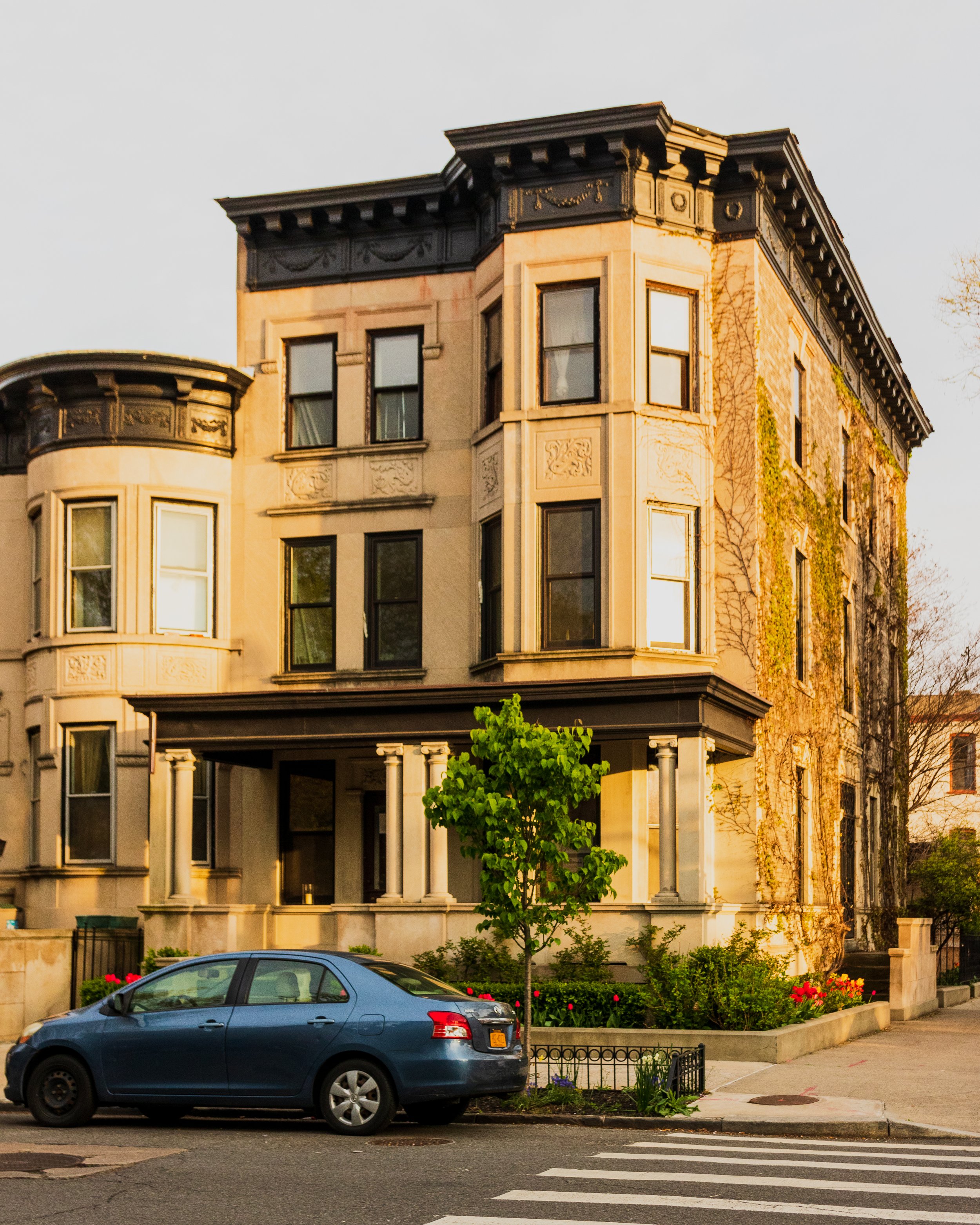
This rather magnificent house is the exclamation point at the end of a row on Rutland Road in Prospect Lefferts Garden. Built in 1910 at the corner of Rutland and Bedford, this house was built in 1910 for William T. Reinking by architect Benjamin Driesler, as one of five houses, the others being a slightly more modest two story set up. This area of Brooklyn was originally part of the independent rural village of Flatbush. Development really took off in the beginning of the 20th Century with the increase in transportation connections from this area of Brooklyn to Manhattan. 118 Rutland Road was landmarked as a part of the Prospect Lefferts Garden Historic District on October 9th, 1979.
60 White Street

One of these days, whenever they finally take down this sidewalk shed, I’ll get another picture of this building, but don’t let perfect be the enemy of good. This is 60 White Street in Tribeca which was very clearly built in 1869. Its owner/developer was Jasper Grosvenor, although interestingly he was dead before construction started. Because this was the 19th Century his wife Matilda oversaw construction on behalf of her late husband, but was never listed as the owner. This was one of three identical buildings constructed by architect William W. Gardiner, Matilda Grosvenor only owned two of the three of them. No. 60 was occupied for a while by Albert G. Hyde & Sons who made cotton goods, which would have been a fairly typical tenant for the neighborhood at the time. And because this is Tribeca, wouldn’t you know the building is now luxury condos. It was landmarked as a part of the Tribeca East Historic District on December 8th, 1992.